

Investment Outlook April 2026: Epic failure and opportunity
Financial Advice
20-04-2026
Investment Outlook April 2026: Epic failure and opportunity
SHARE
Where markets stand right now
In December, our Investment Outlook for 2026 anticipated some moderate volatility after a dramatically turbulent 2025. What we didn’t foresee was the scale of new geopolitical disruptions this year, prompting extended market volatility in March and into April 2026.
We’re watching these events closely. Whether these disruptions cause epic failure or opportunity - perhaps both - remains to be seen.
Our current position
Our outlook has shifted towards more volatility than expected. That said, we remain moderately positive for the year, provided the conflict with Iran can be resolved relatively quickly, within the next two weeks.
If not, supply shortages will start to impact economies globally, and if extended further, the risk of recession rises significantly.
What’s driven markets so far in 2026
Geopolitical events have impacted markets since January:
- Venezuela: Venezuelan military action cased brief concern, which markets brushed off.
- Iran War: From 28th February, a more significant event, driving uncertainty and a sharp sell off into in equity and credit markets.
- Iran War ceasefire: Announced on 7th April, where markets rebounded strongly the following day.
Overall, equity and credit markets are roughly flat for the year to date, a resilient result given the circumstances.
The key factors we’re monitoring
- A backdrop of US fiscal support for 2026 remains in place, offset by the impact of short-term inflation from the oil and related materials supply shock from the Strait of Hormuz closure.
- We are watching the realignment of key US institutions this year, particularly with the appointment of a new Federal Reserve Chair, Kevin Warsh. He has a historical bias towards tighter Federal policy from his previous Federal Reserve role.
- Company earnings have been resilient with analyst expectations trending up, albeit there has been a recent adjustment to this trend, noting we haven’t seen enough data yet to confirm a reversal.
- Inflation should spike in the short term and take some time to settle down if the base case of war resolution helps ease supply.
- Labour markets have softened slightly worldwide, albeit relatively strong in Australia.
- We expect the multi‑year weakening trend in the USD to continue, noting the recent strength is due to a ‘flight to safety’ during periods of active military conflict with Iran.
- Money supply is rising steadily, seen in both national and global M2 measures, expanding bank lending, and increased government spending. Some short-term impacts are expected for consumers and businesses with higher energy and goods prices.
- We think central banks will remain cautious and ‘wait and see’ for the realized impacts from the Iran war to flow through. At the point when the ceasefire took place, some of the market-implied hikes by central banks were reduced, with the US Federal Reserve projected to cut rates later this year. It remains very uncertain what path central banks will actually take before year‑end.
Market scenarios for 2026
Base case
We expect equity markets to finish the year modestly higher, supported by the underlying government spending and US banking regulation easing. We expect an easing of geopolitical risks from ‘peak fear’, while remaining susceptible to volatility and a moderate impact on global economies from global supply shortages. At the time of writing in mid-April 2026, most investors were neutral to underweight equities, and volatility in markets is starting to reduce, setting the scene for a renewed positive market outlook. The business cycle is supportive, being in the early to middle stages of an economic recovery, with the disruption from the war potentially extending the timing of the recovery cycle.
Positive scenarios
There was a relative surplus of oil before the Iran conflict began. While we have seen some adaptation of supply and oil reserves being tapped in the interim, there are still positive policy settings, and potential for even more spending by governments to ease cost-of-living pressures. The most positive outcome depends on a relatively quick resolution to the Iran war, and a more muted impact on actual end consumers and businesses by creative adaptation of other sources and substitutes of supply of energy, fertilisers, petrochemical feed stocks and aluminum.
Negative scenarios
The main risk arises from an extended period of supply disruption of oil and other materials, causing a ramp down of activity in transport and industry. A global recession becomes likely in this scenario as multiple sectors of the economy across governments, businesses, and consumers are affected. A contraction in growth could then lead to a material correction in equity markets beyond 10% down in equities to 20% down or more. In this scenario, inflation initially peaks, central banks hike rates, then inflation falls later as the economy slows down due to less demand.
Asset class views
Credit markets
Credit spreads are above recent lows and have recovered from Iran war highs, reflecting some relief from the ceasefire. Credit remains vulnerable should the negative scenarios play out; however can recover from here if the central and positive scenarios play out.
Equity markets
Despite significant challenges from geopolitical events, equities have been relatively resilient, only slightly down for the year to date in the US and globally in Australian dollar terms, while up in Australia. We could still see positive equity returns for this year, noting that this is very dependent on base case to optimistic scenarios playing out. We would rebalance our portfolios by buying systematically based on significant weakness.
Geopolitical watchpoints
We really can’t predict what will be next from the US, which appears to be disrupting global institutions and resetting expectations for the rest of the world. Elsewhere, we do see a reaction against authoritarianism in Hungary with the recent election win of the pro-EU opposition party. There may well be a reaction against the US President from his voter base at the US mid-term elections later this year. We expect politicians everywhere to be more transactional in the current environment, evidenced by PM Albanese’s multiple trips to Asia to secure fuel supplies.
Long-term themes we’re tracking
These aren’t short-term concerns; they’ll shape investment decisions for years to come:
- Geopolitical and policy volatility is here to stay and must be factored into investment decisions.
- Climate change costs are rising, particularly as data centres and AI drive significant new energy demand.
- ESG investing might be in for a rebound, having been out of favour cyclically.
- High government debt levels create challenges, both in regular refinancing cycles and in times of financial stress.
- Technology adoption is accelerating, with AI, blockchain, hyperscale data, and computing power converging.
- Popular investment themes often overshoot, creating cycles of over and under valuation for thematic strategies.
- Younger generations continue to challenge traditional institutions against the backdrop of a more polarised society.
Current insights linking to the long-term
A few current developments link directly to these themes:
Global alliances are shifting. NATO and other long historical alliances are eroding rapidly, while explorations of more bilateral partnerships and collaborations amongst ‘middle powers’ such as Canada and Australia are growing, highlighting the changing nature of the world order.
Gold remains a resilient safe haven, and concerns arise in the light of rising government debt issuance and higher yields. Central bank holdings in gold have recently overtaken USD-denominated reserve assets in value. We expect central banks to continue this trend to further diversify their reserve portfolios.
Tactical Asset Allocation
|
Factor |
Rationale |
|
Fundamental – Neutral |
Economic and earnings growth have been strong, but the effective closure of the Strait of Hormuz poses a significant risk to the outlook, depending on the duration of the supply disruption and impact on inflation. Leading indicators are beginning to weaken, so we have downgraded our Fundamental view to Neutral, but we expect pent-up demand to drive a rebound in economic growth expectations if the Hormuz closure is short-lived. |
|
Valuation – Neutral |
Earnings growth has seen strong upward revisions leading up to the Middle East war and has remained resilient for now. In conjunction with the moderate pullback in stock prices, valuation multiples have contracted significantly toward long-term historical averages, driving an upgrade to our Valuation view to Neutral. Credit spreads have also moved higher to price in some of this risk. While valuations look more attractive now, supply disruption and inflationary impulses from the war are a risk to the earnings outlook. |
|
Technical – Moderately Positive |
Positioning and sentiment reached pessimistic levels at the end of March. Alongside signs of willingness to de-escalate the Middle East war from both the US and Iran, this has helped drive a rebound in markets. This can provide further support for markets in the near-term, especially with April and May tending to be seasonally strong months. Other technical signals are also turning positive, driving an upgrade to our Technical view. |
|
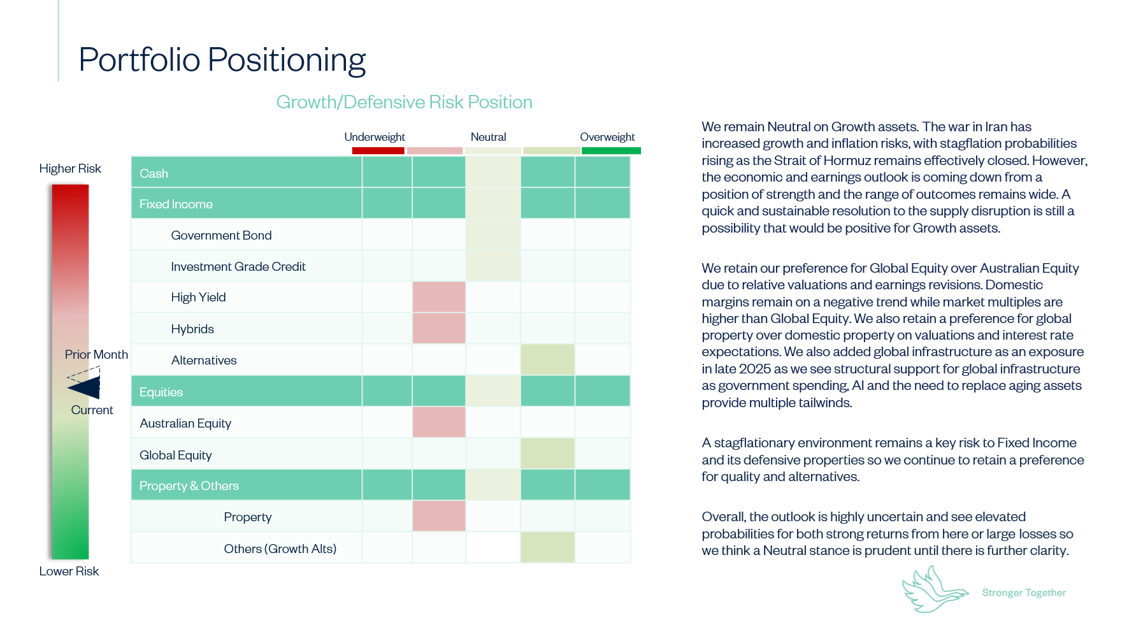
Overall view for growth asset classes – Neutral |
While there have been changes across our Factor categories, the overall view remains Neutral as the downgrade to Fundamental was offset by upgrades to Valuation and Technical. The range of potential scenarios remains wide and highly contingent on the duration of closure for the Strait of Hormuz, and given the uncertain and unpredictable environment, we believe that a rebalancing approach around Neutral positioning is the best way to manage risk in this environment. |
If you have any questions, reach out to your advisor or request a call back.
This investment update has been prepared by Anseres Capital Investments Pty Ltd ABN 82 162 823 083 | AFSL 483842 as investment manager. Anseres Capital Pty Ltd ABN 72 134 627 375 is an authorised representative of Anseres Capital Investments Pty Ltd. Anseres Capital Pty Ltd is a wholly owned subsidiary of Partners Wealth Group Pty Ltd ABN 17 140 105 077. This information is general in nature and has been prepared without taking account of the objectives, financial situation or needs of any particular individual. Before acting on this information, you should consider its appropriateness to your circumstances and, if necessary seek professional advice.