
The job medical school never trained you for
Financial Advice
28-08-2026
The job medical school never trained you for
SHARE
The unspoken shift from clinician to CEO of your own finances
Medical specialists spend a decade or more training to become exceptional clinicians. Almost none of that training prepares them to run the financial side of their own lives, and at some point, usually without much warning, that's exactly what they're asked to do.
This observation comes from our Non-Executive Director Rebecca Comac, a former PwC tax partner turned Partners Wealth Group board member, and the wife to a consultant anaesthetist. She put it plainly at an event we recently hosted for WA's medical community:
"At some point, often without really noticing it, you stop simply being a doctor. You become the CEO of your own financial life."
It's a good way to describe what we see constantly in this profession, and it's worth unpacking why.
A delayed start, then everything at once
The pattern Rebecca described is a familiar one: years of university, years of specialist training, watching friends buy their first homes while you're still sitting exams and working long hours. Then, almost all at once, earning capacity accelerates. Suddenly there's a home to buy, perhaps a practice to buy into, maybe a young family, school fees, ageing parents to support. For many, these decisions are being made as one half of a dual-career household, which shapes everything from how much financial risk feels comfortable to whether private practice gets built aggressively or traded off against flexibility.
The data backs up what that timeline feels like from the inside. There are now roughly 53,000 medical professionals in Australia facing one of the longest lead times to peak income of any profession, and by the time it arrives, many have missed close to a decade of the compounding their friends in law, engineering and corporate careers have already banked, according to 2026 research from CoreData. Medical professionals are represented across five of Australia's top ten professions by average taxable income, yet what's less understood is how hard that income has to work to make up for lost time, and how many other financial demands are competing for it at the same time.
Alongside this, many professionals are not just behind on savings, superannuation and investing, they're also carrying education debt that has been indexed against them the entire time, per BMC Health Services Research (2024). The result is a compressed wealth-building window: the years available to convert peak income into lasting wealth are shorter than they look from the outside, and shorter than they are for peers in other high-earning professions.
Decisions that stop being about medicine
Medical school teaches you how to save lives, but it doesn't teach you how to run a business, build an investment portfolio, or choose good advisors. Yet somewhere around consultant level, an entirely different set of questions starts landing on the same desk: how much to pay yourself, how much superannuation to contribute, whether to own your consulting rooms, how to structure debt, whether profits stay in the business or get distributed, how to protect your income if you can't work, how to build wealth outside the practice, and the list continues.
These aren't just financial decisions. They're family decisions, career decisions, lifestyle decisions, arriving all at once, with no training and often no time.
Familiarity isn't a strategy
Without that training, most people do what anyone would: they rely on recommendations. A practice manager suggests an accountant; a colleague recommends an insurance advisor; and a mortgage broker gets introduced somewhere along the way. As Rebecca put it, sharing a conversation she'd had recently with an orthopaedic surgeon about investing, he laughed and said, "I mostly just do what my dad tells me," and it's a line she hears versions of constantly.
Familiarity with an industry, a colleague's tip, or a family member's approach can absolutely lead to good outcomes. But familiarity isn't the same as strategy. Long-term wealth is rarely built by chasing the next opportunity, it's built by making hundreds of good decisions, consistently, over decades, decisions that reflect your own goals and your own appetite for risk, not somebody else's.
Your greatest asset isn't your portfolio
For many medical specialists, the biggest financial asset they hold isn't their investment portfolio, their home, or their superannuation. It's their ability to practise medicine tomorrow. Protecting that earning capacity, while making smart decisions with the income it generates, is one of the biggest financial challenges of a medical career.
More than 70% of Australian healthcare workers experienced burnout during the COVID-19 pandemic, and while the acute pressure has eased, high patient demand, workforce shortages and administrative load haven't gone away, per the British Medical Journal (2022) and SafeWork Australia's guidance on psychosocial hazards. Reduced hours, enforced leave, or an earlier-than-planned exit from practice can hit right when income is highest. Income protection and business structures that limit personal financial exposure aren't nice-to-haves here, they're core to the plan.
Succession adds another layer, particularly for the roughly 63% of specialists who own their own practice, a figure reported by the Medical Journal of Australia. It's frequently left unaddressed until the final few years, when there's far less room to maximise the outcome. Recent tax reform adds further pressure here too: from 1 July 2027, the 50% CGT discount for individuals, trusts and partnerships is being replaced with cost-base indexation and a 30% minimum tax on capital gains, according to the Australian Treasury. For a specialist selling a practice built up over decades, that's a meaningfully different tax outcome to plan around, and the earlier that planning starts, the more options remain on the table.
Stronger together: why coordinated advice wins for medical specialists
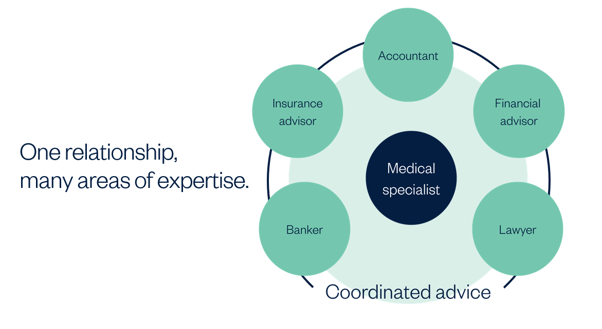
The other problem with borrowed, piecemeal advice is that no single advisor ever sees the whole picture. Your accountant, lawyer, banker, insurance advisor, and financial advisor all see their own slice but never the full picture. For a busy medical specialist, the result is often being the unofficial project manager between half a dozen different professionals who rarely talk to each other.
It's the reason Partners Wealth Group was founded in 2003. We saw clients getting better outcomes when their financial advisor, accountant and other professional advisors worked together, rather than in silos. Trusted professionals moving toward the same destination, sharing information and making decisions together, creates a superior experience for our clients.
Another theme that came through strongly on the night was accessibility. For many medical specialists, advice that is only available during standard office hours simply does not reflect the realities of their working lives. When your schedule is built around patients, theatre lists, consulting sessions and family commitments, an advisor who expects you to fit around their availability can quickly feel disconnected from the profession they are meant to support.
What this means in practice
- Start the structuring conversation before peak income arrives, not after debt and complexity have already stacked up.
- Treat practice ownership as a wealth decision from day one.
- Build income protection and flexible structures around the real possibility of a reduced or earlier-than-planned exit.
- Begin succession planning a decade out.
- Choose advisors who understand the demands of medical practice and are accessible in a way that reflects your schedule, not just theirs.
- Work with advisors who coordinate directly with your accountant and other advisors, rather than operating in isolation.
Reflecting on our recent event
We kept seeing intelligent, highly successful medical specialists trying to navigate increasingly complex financial lives. We hosted this event with one goal in mind: not that specialists would leave with all the answers, but that they'd leave asking better questions.
If you recognise the pattern Rebecca described, it's worth a conversation with an advisor who understands you, your profession, and your industry. Please don't hesitate to contact our office or request a call back.
Sources
- Medical Journal of Australia, practice ownership data: https://onlinelibrary.wiley.com/doi/10.5694/mja2.51038
- Capital Gains Tax and Discretionary Trusts Reform: Small business explainer, Australian Treasury: https://treasury.gov.au/publication/p2026-781365
- BMC Health Services Research, 2024: https://link.springer.com/article/10.1186/s12913-024-11888-y
- RACGP Health of the Nation, 2025: https://www.racgp.org.au/health-of-the-nation-2025/chapter-3-general-practice-funding-and-viability/general-practice-ownership
- Associations of physician burnout with career engagement and quality of patient care: systematic review and meta-analysis, British Medical Journal, 2022: https://doi.org/10.1136/bmj-2022-070442
- Managing psychosocial hazards at work, SafeWork Australia, 2022: https://www.safeworkaustralia.gov.au/sites/default/files/2022-08/model_code_of_practice_-_managing_psychosocial_hazards_at_work_25082022_0.pdf
- Beyond the Practice, NAB Private Wealth / CoreData, 2026 (underlying research on workforce growth and compressed earnings timeline): https://business.nab.com.au/content/dam/nab-business/document/NAB%20Beyond%20the%20Practice%20Whitepaper%202026.pdf
This material contains information that is general in nature. It does not take into account the objectives, financial situation or needs of any particular person. You need to consider your financial situation and needs before making any decisions based on this information. Authorised Representative of Partners Wealth Group Financial Advice Pty Ltd AFS Licence No. 558563 | ABN 33 662 748 496.